
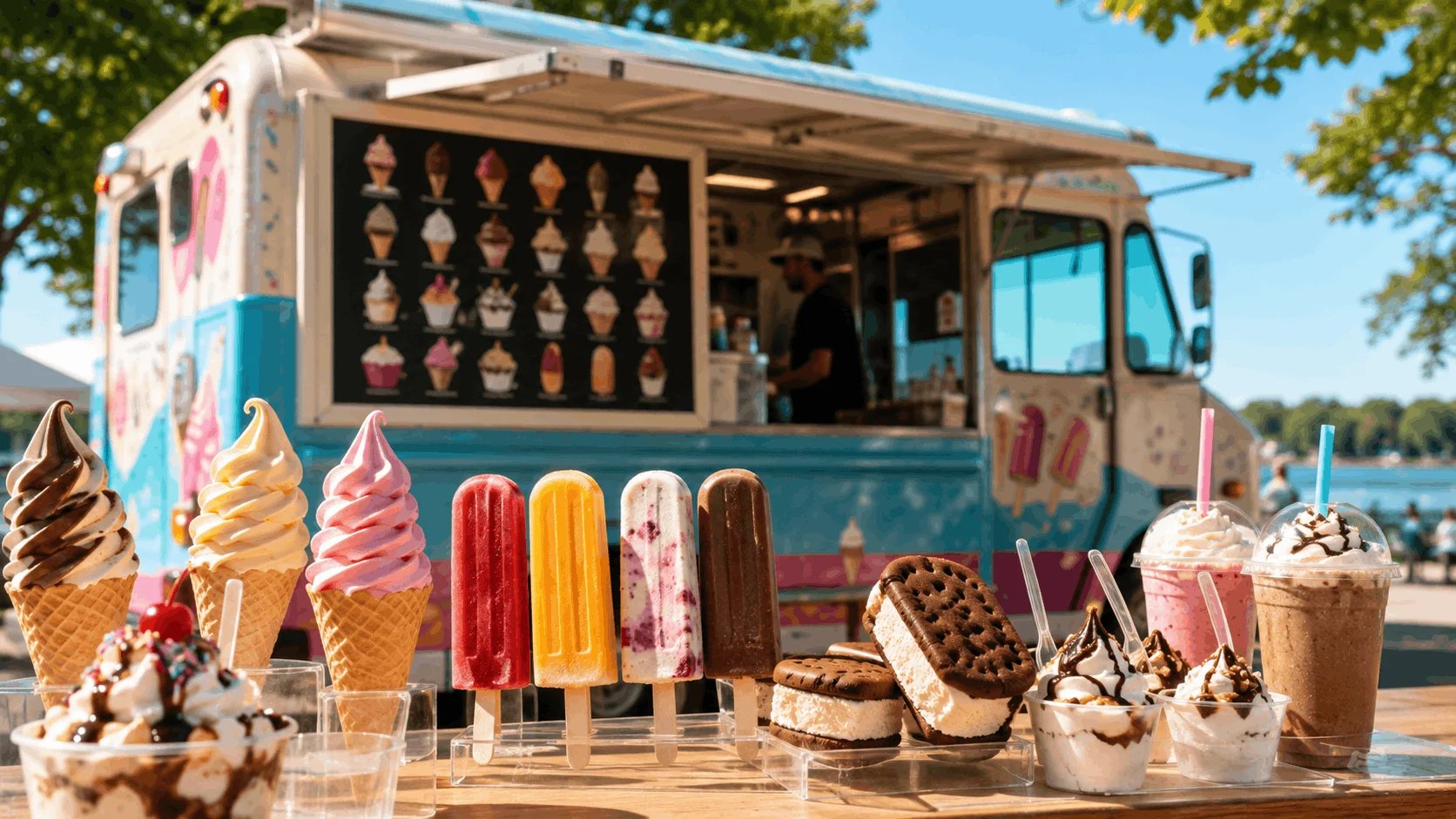
A great ice cream truck menu needs to do two things well: give customers treats they already recognize and make ordering incredibly fast.
Customers standing at an ice cream truck usually don't want to study a huge menu. They want to spot their favorite cone, popsicle, sundae, or ice cream sandwich, see the price, and order.
That makes a focused menu especially important.
In 2026, many U.S. ice cream trucks sell simpler frozen treats for roughly $2.50–$5, while freshly prepared cones, sundaes, shakes, and specialty desserts commonly reach $5–$9 or more, depending on the city, portion size, ingredients, and location. Current operators show similar ranges: Mister Softee Charleston lists cones at $5–$6 and shakes and sundaes at $8, while Fundae Scoops lists two-scoop dishes at $5, waffle cones at $6.50, sundaes at $7, and banana splits at $9.
If you're putting together a new menu, here are 40 ice cream truck menu ideas with suggested 2026 prices to help you get started.
Note: Prices below are suggested starting points for a U.S.-based ice cream truck. Your ideal prices will depend on ingredient costs, location, portion size, competition, permits, labor, and whether you operate regular routes or cater private events.
Classic ice cream truck menu ideas
The classics deserve a prominent place on almost every ice cream truck menu. They're familiar, easy to understand, and usually fast to serve.
1. Vanilla soft serve cone — $4.50
A classic vanilla soft serve cone is one of the safest items you can add to your menu. Keep the base option simple and let customers add sprinkles, sauces, or a waffle cone for an additional charge.
2. Chocolate soft serve cone — $4.50
Chocolate gives customers an easy alternative to vanilla without making your menu more complicated. If your machine supports it, offer vanilla, chocolate, and twist at the same price.
3. Vanilla-chocolate twist cone — $4.50
The twist cone combines both core flavors and often becomes one of the easiest items to upsell with toppings.
4. Chocolate-dipped cone — $5.50
Dip soft serve in a hard chocolate shell for an inexpensive upgrade that feels significantly more premium than a standard cone.
5. Sprinkle cone — $5.00
A soft serve cone covered in rainbow or chocolate sprinkles is visually appealing and particularly easy to market to families.
6. Small ice cream cup — $4.00
Not everyone wants a cone. Offering the same soft serve in a cup gives customers a cleaner and easier-to-eat alternative.
7. Double scoop cone — $5.50
If you serve scooped rather than soft-serve ice cream, a two-scoop cone is a useful middle price point between a basic serving and a premium dessert.
8. Waffle cone — $6.00
Waffle cones can command a higher price than standard cake or sugar cones while requiring very little extra preparation.
Ice cream sandwiches and bars
Pre-packaged treats are valuable for an ice cream truck because they're fast to serve, portion-controlled, and require almost no preparation.
9. Classic ice cream sandwich — $4.00
Vanilla ice cream between two chocolate wafers remains one of the most recognizable ice cream truck products.
10. Chocolate chip cookie ice cream sandwich — $5.50
A premium cookie sandwich gives you a higher-value alternative to the traditional ice cream sandwich.
11. Cookies and cream bar — $4.50
Cookies and cream works well as both an ice cream flavor and a packaged bar because it appeals to a wide range of customers.
12. Strawberry shortcake bar — $4.50
A strawberry ice cream bar coated with crunchy cake crumbs brings a recognizable nostalgic option to the menu.
13. Chocolate éclair bar — $4.50
Chocolate and vanilla ice cream with a crunchy chocolate coating makes another familiar packaged option.
14. Chocolate-covered vanilla bar — $4.00
Keep at least one simple chocolate-coated ice cream bar for customers who aren't interested in novelty flavors.
15. Cookies and cream sandwich — $5.00
Use cookies-and-cream ice cream between chocolate cookies for a slightly more premium alternative to the standard sandwich.
16. Ice cream cookie sandwich with sprinkles — $6.00
Rolling the outside of a cookie sandwich in colorful sprinkles turns a basic product into something much more visually distinctive.
Popsicles and frozen treats
Not every customer wants dairy. Popsicles and frozen fruit treats give your menu inexpensive, refreshing options while helping you serve more dietary preferences.
17. Fruit popsicle — $3.50
Stock several familiar flavors such as strawberry, cherry, orange, grape, or watermelon.
18. Red, white and blue rocket pop — $4.00
Colorful layered frozen pops are strongly associated with traditional ice cream trucks and work particularly well during summer events.
19. Lemon ice pop — $3.50
A tart lemon option provides a refreshing contrast to sweeter ice cream items.
20. Watermelon popsicle — $3.50
Watermelon is easy to understand, seasonal, and especially appropriate for hot summer routes.
21. Strawberry fruit bar — $4.00
Fruit bars made with real fruit can occupy the slightly more premium end of your popsicle category.
22. Mango fruit bar — $4.00
Mango brings another bright, refreshing flavor while helping the menu feel less dependent on traditional vanilla and chocolate products.
23. Frozen lemonade — $5.00
Frozen lemonade sits somewhere between a drink and dessert, giving you another product category without adding much complexity.
24. Italian ice — $4.50
Offer a small selection of flavors such as lemon, cherry, mango, or blue raspberry. Italian ice can also work well as a dairy-free option.
Snow cones and shaved ice
Snow cones are useful because the base product is inexpensive and customers can choose from multiple flavors without requiring you to stock dozens of different frozen products.
Current 2026 menu guides generally place snow cones and shaved ice toward the lower end of ice cream truck pricing, commonly around $2.50–$4.50 depending on serving size and market.
25. Cherry snow cone — $4.00
Cherry is one of the most recognizable snow cone flavors and an obvious starting point for a small menu.
26. Blue raspberry snow cone — $4.00
Bright colors make blue raspberry especially easy to sell from an illustrated or digital menu.
27. Watermelon snow cone — $4.00
Watermelon gives customers another familiar summer flavor without requiring additional equipment.
28. Rainbow snow cone — $4.50
Combine three syrups in one serving. The additional visual appeal makes it reasonable to charge slightly more than for a single flavor.
29. Tropical shaved ice — $5.00
Use mango, pineapple, coconut, or passion fruit flavors to create a more premium shaved ice option.
Sundae menu ideas
Sundaes give customers a reason to spend more than they would on a basic cone. They also make good use of ingredients you're already carrying for toppings.
Current operators demonstrate how premium these items can become. Fundae Scoops lists sundaes at $7, while Mister Softee Charleston lists them at $8.
30. Hot fudge sundae — $7.00
Vanilla soft serve, hot fudge, whipped cream, and a cherry create an easy premium product using a small number of ingredients.
31. Caramel sundae — $7.00
Use the same basic sundae format and replace the fudge with caramel sauce. This keeps inventory manageable while adding another menu choice.
32. Strawberry sundae — $7.00
Strawberry sauce works particularly well during spring and summer and adds a lighter alternative to chocolate and caramel.
33. Cookies and cream sundae — $7.50
Top vanilla or chocolate ice cream with crushed chocolate sandwich cookies, sauce, and whipped cream.
34. Brownie sundae — $8.50
Adding brownie pieces creates a noticeably more substantial dessert, allowing you to move into a higher price tier.
35. Banana split — $9.00
A traditional banana split with banana, multiple scoops, sauces, whipped cream, and cherries can become one of the premium items on your ice cream truck menu. Current ice cream truck menus show banana splits around this price point, although elaborate versions can cost more.
Milkshakes, floats, and drinks
Drinks can increase average order value while giving customers options beyond traditional frozen desserts.
36. Vanilla milkshake — $7.00
Start with a simple vanilla shake and use it as the base for additional flavors.
37. Chocolate milkshake — $7.00
Chocolate is likely to be one of your most recognizable shake options and requires little explanation on the menu.
38. Strawberry milkshake — $7.00
A three-flavor shake lineup of vanilla, chocolate, and strawberry keeps the category simple while giving customers enough choice.
39. Cookies and cream milkshake — $8.00
Add crushed cookies to your standard milkshake base and position it as the premium shake option.
40. Root beer float — $7.00
Vanilla ice cream and root beer require very little preparation but give customers something different from a conventional cone or shake.
Ice cream truck menu price list for 2026
Using the ideas above, a simple pricing structure could look like this:
Menu category | Suggested price range |
|---|---|
Popsicles | $3.50–$4.00 |
Packaged ice cream bars | $4.00–$4.50 |
Ice cream sandwiches | $4.00–$6.00 |
Snow cones | $4.00–$5.00 |
Soft serve cones | $4.50–$6.00 |
Ice cream cups | $4.00–$6.00 |
Sundaes | $7.00–$8.50 |
Banana splits | Around $9.00 |
Milkshakes | $7.00–$8.00 |
Floats | Around $7.00 |
These numbers shouldn't be treated as fixed industry prices. Ice cream truck pricing varies considerably between small towns, large cities, tourist destinations, festivals, and private events. A truck selling at a major event may reasonably charge considerably more than one operating a regular neighborhood route.
How many items should an ice cream truck menu have?
You don't need all 40 ideas.
In fact, trying to offer every possible flavor and dessert can make an ice cream truck harder to operate. Customers take longer to decide, inventory becomes more complicated, and slower preparation can create lines.
For many trucks, 15–25 well-chosen items is enough.
A practical menu might include:
- 3 soft serve options
- 4–6 packaged bars and sandwiches
- 4 popsicles or frozen treats
- 2 snow cone options
- 3 sundaes
- 3 milkshakes or floats
You can always rotate additional flavors as seasonal specials.
If you're starting from scratch, our Ice cream truck menu template can help you organize your categories, items, prices, and QR code menu. Trucks serving a wider food selection can also use the Food truck menu template, while businesses focused mainly on scooped ice cream can start with the Ice cream menu template.
How to price an ice cream truck menu
Don't choose your prices simply by copying another truck. Your menu needs to cover the actual cost of running your business.
Start by calculating the cost of the product itself, including the cone, cup, spoon, napkin, toppings, sauces, and packaging. Then account for operating expenses such as fuel, vehicle maintenance, refrigeration, insurance, payment processing, licenses, permits, labor, and wasted inventory.
Location matters too. An ice cream truck serving a residential neighborhood may need lower entry prices than one operating at festivals, weddings, sports tournaments, or tourist destinations.
A useful menu also includes multiple price levels. For example, you might have a $3.50 popsicle as your inexpensive option, a $5 cone as your core item, a $7 sundae, and an $8 specialty shake. Customers can then choose according to their budget instead of deciding whether your entire menu is simply "cheap" or "expensive."
Use add-ons to increase the average order
You don't always need more menu items to make more revenue. Sometimes the easiest option is allowing customers to customize products they already want.
Simple add-ons could include:
Add-on | Example price |
|---|---|
Sprinkles | +$0.50 |
Chocolate sauce | +$0.50 |
Caramel sauce | +$0.50 |
Cookie crumbs | +$0.75 |
Chocolate shell | +$1.00 |
Waffle cone | +$1.00 |
Extra scoop | +$1.50–$2.00 |
Premium topping | +$1.00 |
The important part is keeping the choices manageable. Five clearly displayed toppings are usually more useful than twenty toppings customers need to read through.
Create a kids section
Families are one of the most important audiences for many ice cream trucks, so it can be useful to make several lower-priced treats particularly easy to find.
Instead of creating completely separate products, group your existing smaller items together. Popsicles, small cups, mini cones, and fruit bars can all work well here.
You could label the section Kids' Favorites, Little Treats, or simply Under $5.
The last option has an additional advantage: parents immediately know which items fit within a particular budget.
Don't forget dairy-free options
An ice cream truck doesn't need an enormous specialty menu, but including several clearly labeled dairy-free choices makes the menu useful to more customers.
Fruit popsicles, Italian ice, frozen lemonade, and some sorbets can provide alternatives without requiring you to recreate your entire menu.
Just make sure dietary labels accurately reflect the ingredients and preparation process of the products you're selling.
Keep your menu easy to scan
An ice cream truck menu is often read outdoors, from several feet away, while other people are waiting in line. That makes simplicity more important than clever menu descriptions.
Group similar products together under clear headings such as:
Cones & Cups → Ice Cream Bars → Popsicles → Snow Cones → Sundaes → Shakes & Drinks
Keep the product name and price visually prominent. Descriptions should only be added when customers genuinely need more information about what's included.
You can explore additional layouts in the restaurant menu templates
Consider using a QR code menu
The traditional menu board on the side of the truck isn't going away, but a digital menu can work alongside it.
Customers can scan a QR code while they're waiting, which gives them more time to browse your menu before reaching the window. You can also share the same menu link through Instagram, Google Business Profile, your website, event pages, or catering inquiries.
A digital menu is particularly helpful when prices change. Instead of replacing printed boards every time an item becomes more expensive or goes out of stock, you can update the menu online.
mmmmenu's ice cream truck menu maker lets you add products and prices, customize the design, publish a mobile-friendly menu, and generate a QR code for customers to scan. The menu can also be updated after publishing without needing to reprint it.
Example ice cream truck menu
If you want to keep things simple, you could launch with a menu like this:
Cones & Cups
Vanilla Soft Serve — $4.50
Chocolate Soft Serve — $4.50
Vanilla & Chocolate Twist — $4.50
Chocolate-Dipped Cone — $5.50
Waffle Cone — $6.00
Frozen Favorites
Classic Ice Cream Sandwich — $4.00
Strawberry Shortcake Bar — $4.50
Cookies & Cream Bar — $4.50
Fruit Popsicle — $3.50
Rocket Pop — $4.00
Snow Cones
Cherry — $4.00
Blue Raspberry — $4.00
Rainbow — $4.50
Sundaes
Hot Fudge — $7.00
Caramel — $7.00
Cookies & Cream — $7.50
Brownie Sundae — $8.50
Shakes & Floats
Vanilla Shake — $7.00
Chocolate Shake — $7.00
Cookies & Cream Shake — $8.00
Root Beer Float — $7.00
This gives customers plenty of choice without turning the truck into a full ice cream shop.
Frequently asked questions about ice cream truck menus
How much does ice cream from an ice cream truck cost in 2026?
Many basic ice cream truck treats in the U.S. cost around $3–$5, while cones, specialty desserts, sundaes, and shakes commonly fall around $5–$9 or more. Pricing varies significantly based on location, portion size, product costs, and whether the truck is serving a regular route or an event.
What should be on an ice cream truck menu?
A strong ice cream truck menu usually includes a combination of cones, cups, ice cream sandwiches, packaged bars, popsicles, snow cones, sundaes, and a few drinks or shakes. You don't need every category if it doesn't fit your equipment or business model.
What are the most popular ice cream truck items?
Soft serve cones, ice cream sandwiches, popsicles, novelty bars, snow cones, sundaes, and milkshakes are among the most recognizable ice cream truck products. The best sellers for an individual truck will depend on its location and audience.
How many items should an ice cream truck sell?
Around 15–25 core items gives many operators enough variety without making the menu difficult to understand or inventory difficult to manage. Trucks specializing in packaged novelties may stock more, while a soft-serve-focused truck can operate successfully with fewer products.
What are good inexpensive items for an ice cream truck?
Popsicles, fruit bars, small cups, snow cones, and basic ice cream sandwiches can help create a lower-priced section of the menu. Having several affordable choices is particularly useful when serving families.
Should an ice cream truck show prices on the menu?
Yes. Displaying prices clearly makes ordering faster and helps customers decide what they want before reaching the service window. It can also reduce repetitive questions during busy periods.
Should an ice cream truck have a QR code menu?
A QR code menu can complement the physical menu displayed on your truck. Customers can scan it while waiting, and you can share the same menu online. Digital menus are particularly convenient when products, availability, or prices change frequently.
How can I create an ice cream truck menu?
Start by dividing products into a few clear categories, adding straightforward item names and prices, and keeping the menu easy to scan. You can use an ice cream truck menu template to create a digital menu, customize its appearance, and generate a QR code customers can scan.