
A good shisha menu shouldn't feel like an endless list of flavor names.
Customers need to quickly understand what's available, how flavors differ, which combinations work together, what the different price tiers mean, and what else they can order while they stay.
That becomes difficult when a hookah lounge has 30, 50, or even 100 flavors. Put everything into one alphabetical list and first-time customers may have no idea where to start.
The better approach is to organize the menu around how people actually order: familiar flavors, house mixes, premium options, strength or style, upgrades, and drinks.
Current hookah lounge menus already use several versions of this structure. Merhaba separates classic flavors from signature collections, Babylon groups standard and premium options with add-ons, while La Vetta distinguishes single flavors, combinations, and signature blends.
If you're building or redesigning a menu, here are practical shisha menu ideas and examples you can use.
Important: Shisha tobacco contains nicotine and is age-restricted in many markets. Local laws covering tobacco sales, indoor smoking, advertising, health warnings, and minimum ages vary considerably, so make sure your menu and operation comply with the rules where your lounge operates.
1. Start with classic shisha flavors
Your first section should make ordering easy for customers who already know what they like.
Instead of forcing them to browse every brand and blend, create a section such as:
Classic Flavors
- Double Apple
- Mint
- Grape
- Lemon
- Lemon Mint
- Blueberry
- Watermelon
- Peach
- Orange
- Strawberry
- Mango
- Guava
- Kiwi
- Rose
- Vanilla
- Coconut
These are exactly the kinds of recognizable flavors that repeatedly appear on current lounge menus. Manjaros, Tangerine Hookah Lounge, Babylon, and La Vetta all feature combinations of apple, mint, grape, blueberry, peach, citrus, watermelon, and similar fruit profiles.
You don't necessarily need to list every flavor you stock. If you have a very large inventory, show the most popular options first and add something like:
More flavors available — ask your server.
That keeps the menu readable without limiting what your team can offer.
2. Group flavors by taste
Another way to make a large selection easier to browse is to organize flavors by profile rather than alphabetically.
For example:
Fruity
Watermelon
Peach
Mango
Blueberry
Strawberry
Pineapple
Passion Fruit
Guava
Fresh & Minty
Mint
Lemon Mint
Grape Mint
Citrus Mint
Gum Mint
Sweet
Vanilla
Bubblegum
Coconut
Cream
Melon
Traditional
Double Apple
Grape
Rose
Mint
This is especially useful for customers who don't know the names of particular blends.
Someone may not know whether they want "Flavor X," but they probably know whether they're looking for something fresh, fruity, sweet, citrusy, or traditional.
3. Create signature house mixes
Signature mixes are one of the easiest ways to give your lounge a menu customers can't simply compare with the venue next door.
Rather than only listing:
Watermelon
Mint
Blueberry
create a blend such as:
Sunset
Watermelon · Blueberry · Mint
Sweet, fruity and cooling.
Current lounges commonly use this approach. Tangerine Hookah Lounge promotes house-exclusive combinations, Hukka Lounge gives its blends individual names, and Merhaba presents a separate collection of curated flavor profiles.
Here are some shisha mix ideas you could adapt.
Citrus Garden
Lemon · Orange · Mint
Bright citrus with a fresh finish.
Berry Chill
Blueberry · Raspberry · Mint
Sweet berries balanced with cooling mint.
Tropical Sunset
Mango · Pineapple · Passion Fruit
A sweeter tropical combination.
Fresh Melon
Watermelon · Melon · Mint
Light, fruity and refreshing.
Peach Breeze
Peach · Lemon · Mint
Soft peach with fresh citrus.
Apple Garden
Double Apple · Mint
A simple variation on a traditional favorite.
Tropical Cream
Coconut · Vanilla · Pineapple
Sweeter and more dessert-like.
Grape Citrus
Grape · Lemon · Mint
Fruit-forward with a sharper citrus finish.
Berry Lemonade
Strawberry · Blueberry · Lemon
Sweet berries with bright lemon.
House Special
Create one combination that represents your lounge and place it at the top of the menu.
The important part isn't necessarily inventing complicated combinations. It's making your house mixes easier to order than asking customers to build everything themselves.
4. Don't name every blend without explaining it
Creative names can make your menu memorable, but they can also make it harder to understand.
A menu filled with options such as:
Midnight Dubai
Purple Cloud
Paradise 66
Secret Garden
doesn't tell a first-time customer much.
Keep the creative name, but show the ingredients or flavor profile directly underneath.
For example:
Purple Cloud
Blueberry · Grape · Mint
Fruity / Fresh
This lets regular customers order by name while new visitors still know what they're getting.
5. Add simple flavor descriptions
Shisha descriptions don't need to become cocktail-menu poetry.
For most items, a few words are enough.
Instead of:
Watermelon
try:
Watermelon
Sweet · Light · Fruity
Instead of:
Lemon Mint
use:
Lemon Mint
Citrusy · Fresh · Cooling
And instead of:
Double Apple
use:
Double Apple
Traditional · Apple · Anise
Some contemporary lounges are already moving toward this format. Da Vibe, for example, describes options in terms of flavor character and finish rather than presenting only a catalog of names.
This is particularly useful for visitors trying shisha for the first time.
6. Let customers choose by strength or intensity
If your products and local regulations allow you to accurately communicate intensity, another useful menu structure is to separate choices into categories such as:
Light
Fruit-forward and easygoing profiles.
Medium
Balanced mixes with stronger flavor.
Bold
More intense profiles intended for experienced customers.
A lounge in Warsaw, for example, allows guests to choose a nicotine strength on a numbered scale for some of its shisha offerings.
If you use a strength system, make sure it actually corresponds to the product being prepared. Don't use vague labels that could imply that tobacco smoke is harmless or "safe."
You can also clearly identify tobacco-free or nicotine-free alternatives when you genuinely offer them.
7. Separate classic and premium shisha
If your lounge carries products at different price points, don't force customers to figure out why two seemingly similar options cost different amounts.
Create clear tiers.
For example:
Classic Shisha
Choose one classic flavor.
House Mixes
Choose one of our signature combinations.
Premium Selection
Premium flavor range and specialty blends.
Specialty Experience
Premium setup or special presentation.
This model is already common. Babylon separates standard tobacco from a higher-priced premium range, Merhaba divides classic and premium-style collections, and Divana has separate standard and dark-leaf sections.
The advantage is that customers understand the menu before they even compare individual options.
8. Add mix-your-own options
Some guests already know exactly what combination they want.
Rather than listing every possible variation, create a simple customization rule.
For example:
Create Your Own Mix
Choose any 2 flavors
or:
Choose up to 3 flavors
You can then keep the individual flavor list relatively compact.
This structure is especially useful on a digital menu because customers can first browse signature combinations and only build their own if none of those appeal.
9. Offer clear upgrades
Many lounges have optional upgrades or alternative preparations.
Depending on what you actually offer, this section might contain:
Add-ons
- Ice hose
- Fresh fruit head
- Premium bowl
- Flavor refill
- Extra hose
- Specialty base
- Fresh fruit presentation
Existing lounges use similar structures. Zodiac lists upgrades such as fruit heads and ice hoses, while Babylon offers fresh fruit heads and multi-flavor configurations.
Keep upgrades in their own section rather than attaching a long list of options beneath every shisha.
10. Explain refills clearly
If you offer bowl or head replacements, make the difference between a refill and a completely new setup obvious.
For example:
New Bowl
Fresh preparation with your selected flavor.
Bowl Refill
Replacement bowl for your existing setup.
Change Flavor
Choose a different flavor for your next bowl.
This reduces questions and makes your pricing much easier to understand.
Current menus use several different refill structures. Babylon lists additional mixes and upgrades separately, while Zodiac advertises a dedicated refill price.
11. Keep the main shisha menu relatively short
Having 80 flavors available doesn't mean 80 flavors need equal prominence.
A stronger structure might be:
- 12–20 classic flavors
- 6–10 house mixes
- 5–10 premium options
- 3–5 upgrades
- Custom mix option
You can keep additional flavors available on request.
This gives guests enough variety while making decisions significantly easier.
12. Highlight your most popular choices
Customers often want reassurance that they're ordering something other people enjoy.
Use subtle labels such as:
House Favorite
Most Popular
Staff Pick
Traditional Favorite
You could place them beside only three or four items.
For example:
Berry Chill
Blueberry · Raspberry · Mint
House Favorite
Double Apple
Traditional apple and anise profile.
Classic
Citrus Garden
Lemon · Orange · Mint
Staff Pick
Avoid marking half the menu as "popular." Once everything is highlighted, nothing stands out.
13. Create seasonal shisha mixes
A small seasonal section gives regular guests something new without requiring you to rebuild the permanent menu.
Summer
Watermelon · Lime · Mint
Tropical Season
Mango · Pineapple · Passion Fruit
Autumn
Apple · Vanilla · Cinnamon-style flavor
Winter Citrus
Orange · Lemon · Mint
You could rotate three or four seasonal combinations every few months.
A digital menu makes this particularly convenient because you can update the section without printing new menus each time.
14. Consider pairing shisha with drinks
People often spend considerably longer at a hookah lounge than they would when ordering a quick coffee or meal.
Your drinks menu therefore matters just as much as the shisha section.
Current lounges commonly combine hookah with soft drinks, tea, coffee, mocktails, cocktails, and snacks. Babylon presents shisha alongside drinks and a broader food menu, while Rūkas in Vilnius combines its hookah offering with cocktails, lemonades, coffee, tea, and other beverages.
You don't necessarily need explicit pairings for every item, but you can use occasional recommendations such as:
Lemon Mint
Pairs well with mint tea or citrus lemonade.
Double Apple
Try with black tea.
Tropical Sunset
Pairs well with passion fruit lemonade.
This can make the whole menu feel more intentionally designed.
15. Add a proper tea section
Tea fits naturally into a hookah lounge menu and gives you a strong non-alcoholic category.
Possible options include:
Tea
Moroccan Mint Tea
Persian Black Tea
Jasmine Green Tea
Earl Grey
Fresh Mint Tea
Chai
Fruit Tea
Oolong Tea
Deluxe Hookah Lounge, for example, includes Persian black tea, Middle Eastern green tea, and chai alongside its hookah menu, while Rūkas offers black, green, fruit, white, herbal, oolong, and pu-erh teas.
If you serve tea by the pot, show that clearly on the menu.
16. Build a mocktail and lemonade section
Alcohol-free drinks can pair particularly well with long lounge visits.
A simple section might include:
Fresh Lemonades
Classic Lemon
Passion Fruit
Strawberry
Peach
Mojito Mint
Mocktails
Virgin Mojito
Passion Fruit Fizz
Berry Lemonade
Mango Cooler
Watermelon Mint Cooler
You don't need 25 drinks. Five or six good options can provide plenty of choice.
If drinks are an important part of your business, you can organize them separately using a drink menu template.
17. Add cocktails separately when appropriate
If your venue serves alcohol and is licensed to do so, don't mix cocktails into the middle of the shisha section.
Create a clear section:
Signature Cocktails
Classics
Mocktails
Spirits
Beer & Wine
This makes browsing considerably easier.
For lounges where cocktails are a major part of the concept, a dedicated cocktail bar menu template can also help separate the drinks experience from the shisha selection.
18. Add simple sharing food
Food doesn't need to turn your hookah lounge into a full restaurant.
If customers stay for several hours, a compact selection of easy-to-share food can be enough.
Examples include:
Small Plates & Snacks
Hummus & Flatbread
Loaded Fries
Chicken Wings
Halloumi Fries
Nachos
Olives
Mixed Nuts
Falafel
Mozzarella Sticks
Chicken Tenders
Focus on foods that are easy to eat while sitting around a table and don't require guests to interrupt the social experience.
If your lounge already operates a kitchen, food can of course become a much larger part of the menu.
19. Add desserts that fit the lounge experience
Desserts can work particularly well with sweeter shisha profiles and hot drinks.
Possible options include:
- Baklava
- Cheesecake
- Chocolate cake
- Brownie with ice cream
- Kunafa
- Tiramisu
- Waffles
- Crêpes
- Ice cream
- Fresh fruit platter
Again, there's little reason to offer all of them. Choose a handful that fit your concept and kitchen.
20. Make prices extremely easy to understand
One common problem with hookah menus is unclear pricing.
Customers may see:
Classic — $X
but not know whether that price is per person, per hookah, per bowl, or per table.
Spell it out.
For example:
Classic Shisha — $XX
One hookah · Choose one classic flavor
House Mix — $XX
One hookah · Choose any signature mix
Premium — $XX
One hookah · Premium selection
Refill — $XX
Fresh bowl for your existing hookah
Pricing varies substantially between markets. Current U.S. examples range from around $15–$25 for some standard offerings to $40 or more at other venues, while Rūkas in Vilnius lists classic shisha at €24.
Instead of trying to match another lounge's price, base yours on your own costs, market, service model, location, and local taxes.
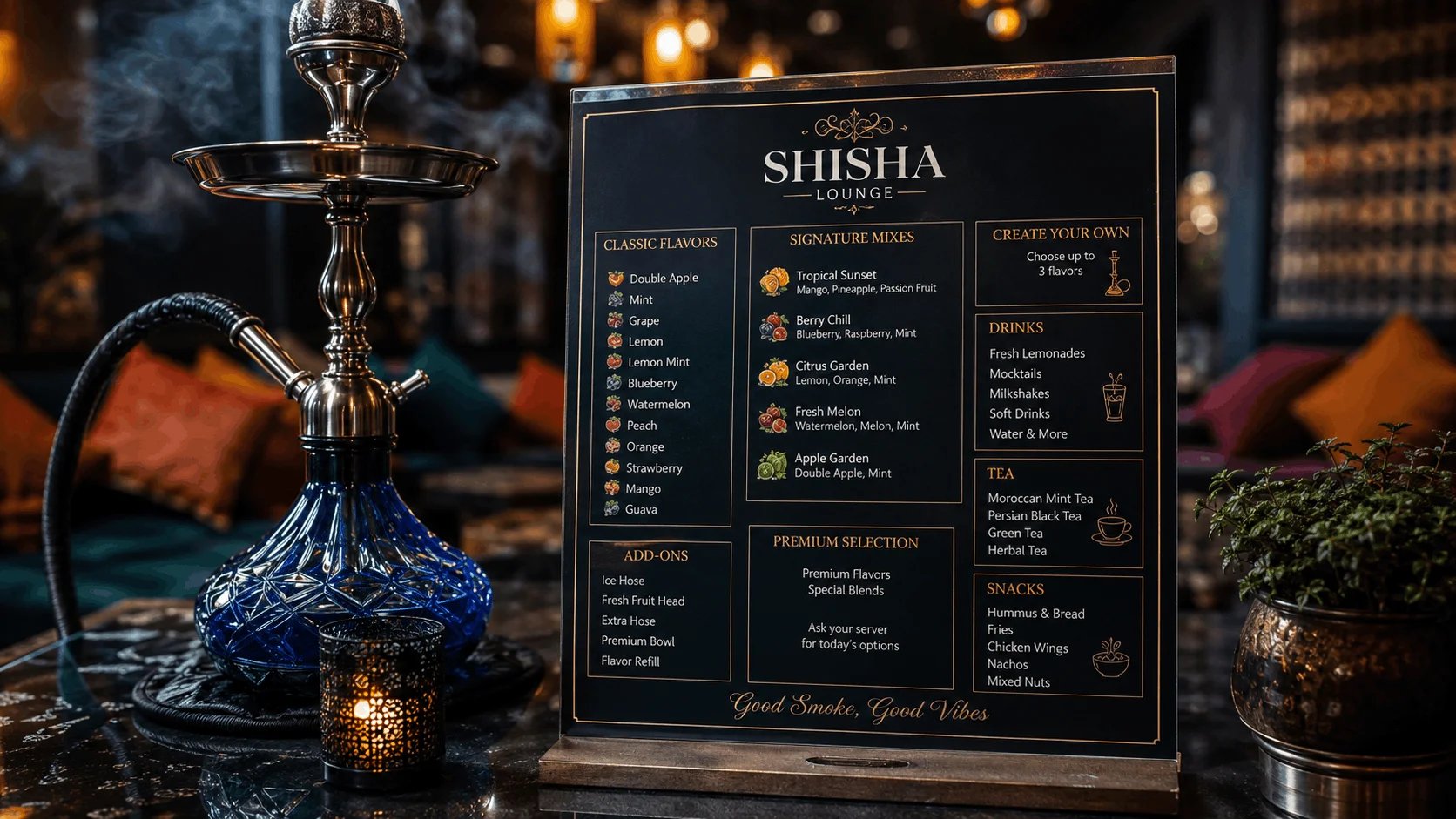
Example hookah lounge menu
Putting everything together, a compact menu could look like this:
Classic Shisha
Double Apple
Traditional · Rich · Anise
Grape Mint
Fruity · Fresh
Lemon Mint
Citrus · Cooling
Blueberry
Sweet · Berry
Watermelon
Light · Fruity
Peach
Sweet · Smooth flavor profile
Mint
Fresh · Cooling
Mango
Tropical · Sweet
Signature Mixes
Citrus Garden
Lemon · Orange · Mint
Berry Chill
Blueberry · Raspberry · Mint
Tropical Sunset
Mango · Pineapple · Passion Fruit
Fresh Melon
Watermelon · Melon · Mint
Peach Breeze
Peach · Lemon · Mint
House Special
Ask about today's signature blend.
Premium Selection
A rotating selection of premium flavors and blends.
Ask your server for today's options.
Customize
Create Your Own Mix
Choose up to three flavors.
Add-ons
Fresh Fruit Head
Ice Hose
Extra Bowl
Premium Upgrade
Tea
Moroccan Mint Tea
Persian Black Tea
Jasmine Green Tea
Chai
Lemonades
Classic Lemon
Passion Fruit
Strawberry
Mojito Mint
Snacks
Hummus & Flatbread
Halloumi Fries
Chicken Wings
Loaded Fries
Desserts
Baklava
Chocolate Brownie
Cheesecake
This is much easier to navigate than a single page containing 70 unorganized flavor names.
How should you organize a shisha menu?
A practical order is:
- House Favorites
- Classic Flavors
- Signature Mixes
- Premium Selection
- Create Your Own
- Add-ons
- Drinks
- Food & Desserts
Put the options you most want customers to notice near the beginning.
Don't automatically organize the entire menu around tobacco brands. Brand categories may make sense to experienced customers, but people unfamiliar with shisha generally find flavor and style much easier to understand.
Keep shisha menu descriptions short
A digital shisha menu should be easy to browse on a phone.
That means you usually don't need descriptions such as:
A carefully crafted fusion of luscious watermelon and deliciously refreshing mint that creates an unforgettable flavor journey.
Use:
Watermelon Mint
Watermelon · Mint
Sweet · Fresh
The customer understands the product immediately.
Save longer descriptions for genuinely distinctive signature options.
Use images selectively
A picture beside every individual flavor probably won't add much value. Blueberry, grape, and mint don't need separate stock photos.
Images are more useful for:
- Signature presentations
- Fresh fruit heads
- Premium setups
- Food
- Desserts
- Cocktails
- Tea service
One strong photo can communicate more than ten generic fruit images.
Don't overcrowd the design
Hookah lounges often have distinctive interiors, branding, lighting, and atmosphere. It's tempting to recreate all of that in the menu with dark backgrounds, gradients, smoke effects, neon graphics, ornate fonts, and dozens of colors.
The menu still needs to be readable.
Use the lounge's visual identity, but keep strong contrast between the background, product names, descriptions, and prices.
Especially on mobile, clarity should come before decoration.
Create a QR code shisha menu
A hookah lounge is particularly well suited to a digital menu because flavor availability, premium selections, seasonal mixes, prices, and drinks can change regularly.
Instead of reprinting your menus whenever something changes, you can update the digital version.
With mmmmenu's Shisha menu template, you can add flavors, signature mixes, descriptions, prices, drinks, and food, customize the menu design, and generate a QR code customers can scan at the table. Updates can then be published without replacing the QR code.
You can also share the same menu link through your website, Google profile, Instagram, or other social channels.
Frequently asked questions about shisha menus
What should be included on a shisha menu?
A good shisha menu usually includes classic flavors, signature mixes, premium options, custom mixes, prices, and any available upgrades. Hookah lounges can also add tea, soft drinks, mocktails, food, and desserts.
What are popular shisha flavors?
Common flavors found across many current hookah lounge menus include double apple, mint, grape, lemon, blueberry, watermelon, peach, orange, strawberry, mango, and combinations that mix fruit with mint.
How should I organize shisha flavors?
You can organize flavors by type—such as fruity, fresh, sweet, and traditional—or separate them into classics, signature blends, and premium selections. Both approaches are usually easier to browse than one long alphabetical list.
How many shisha flavors should be on a menu?
There's no fixed number. Even if you stock dozens of flavors, consider highlighting around 15–25 popular choices and keeping additional options available on request. You can then add a smaller collection of signature mixes.
What are good shisha mix ideas?
Simple combinations include watermelon and mint, grape and mint, blueberry and mint, lemon and mint, mango and pineapple, or orange, lemon, and mint. Signature combinations can use two or three complementary flavors and be given a memorable house name.
Should a hookah lounge have signature mixes?
Signature mixes can make ordering easier and help distinguish your menu from competitors. Keep the ingredients visible underneath any creative name so customers immediately understand the flavor profile.
Should shisha prices be shown on the menu?
Yes. Make prices clear and explain what each price includes, particularly if you have different rates for classic, premium, refill, or specialty setups.
Should a shisha lounge use a QR code menu?
A QR code menu can be useful for hookah lounges because flavors, prices, drinks, and availability may change regularly. A digital menu can be updated without reprinting and can also be shared through a website or social media.